WHAT IS YOUR PROJECT ABOUT?

    Inside the VFX of Young Washington: A BOT VFX Breakdown


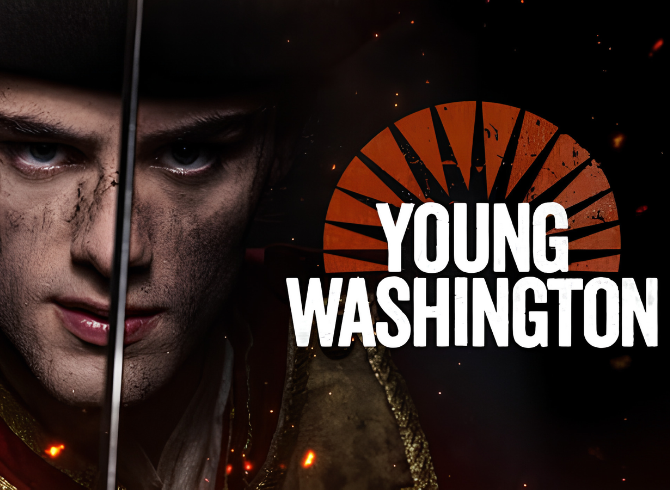
    Young Washington tells the story of George Washington’s early years, before he became one of the most important figures in American history. Set against the backdrop of the French and Indian War, this film follows his experiences as a young military officer, from the challenges of leadership to the realities of 18th-century warfare. The story takes us through large-scale battles, colonial towns and the American wilderness, providing plenty of opportunities for visual effects to help bring this period to life.

    As VFX Supervisor at BOT VFX, I oversaw the delivery of over 300 shots across a 17-week schedule. The work covered a wide range of disciplines, from large-scale battle enhancements and historical environment extensions to fully AI-generated shots and traditional CG effects.

    One of the more interesting aspects of this project was the extensive use of generative AI throughout the production. Working with a combination of client-supplied and internally generated AI material, we developed workflows to integrate and enhance the imagery using traditional VFX techniques. This allowed us to expand environments, build larger crowds and create complex action sequences while maintaining the visual quality and consistency required for the film.

    Battle Sequences

    The film features several major battles, with visual effects playing an important role in expanding the scale of the action and bringing the combat to life.

    Much of the work involved enhancing practical photography with additional soldiers, cavalry, wagons and battlefield activity. We incorporated AI-generated elements to create larger groups of soldiers and entire battalions, helping turn relatively small practical setups into much larger military engagements.

    The visual effects for the combat sequences combined AI-generated elements with traditional CG and compositing. These effects included musket muzzle flashes, cannon fire, explosions, smoke, flying cannonballs and bullets, along with blood hits and wounds. We also created burning wagons and additional environmental destruction to increase the intensity of the fighting.

    One of the main challenges was integrating all these different elements into the original photography. The scale and placement of the soldiers needed to feel natural, while the smoke, fire, and explosions had to work with the existing lighting, camera movement and action.

    By combining AI-generated material with traditional VFX techniques, we were able to significantly increase the scale and complexity of the battle sequences while maintaining the realism needed for the film.

    Icy River Sequence

    The icy river sequence was one of the more technically challenging parts of the project, combining practical character photography with AI-generated environments and additional CG work.

    Several shots were created almost entirely using generative AI, including expansive frozen landscapes, dense forests, flowing rivers and icy water. These were combined with practical performances and traditional VFX elements to create a consistent detailed environment across the sequence.

    The work also involved extending and enhancing the surrounding landscape, adding forests and terrain, and integrating atmospheric effects to establish the cold, isolated setting. Additional character work included face replacements, while modern-day elements were removed when necessary.

    One of the biggest challenges was bringing AI-generated imagery up to the QC standard required for final delivery. Although the generated material provided a strong foundation, it often required considerable additional work to meet the creative and technical requirements of the film.

    This included upscaling the imagery to 4K, addressing temporal inconsistencies and cleaning up artifacts that became more noticeable at higher resolutions. The limited bit depth of some AI-generated material also presented challenges during compositing and colour adjustments.

    The sequence required a combination of AI generation, CG environment work and detailed compositing to bring all the elements together and maintain visual consistency from shot to shot.

    Town Environments

    A significant part of the work involved creating and extending the historical towns and settlements featured throughout the film.

    Some shots were generated almost entirely using AI, while others started with practical photography and were expanded using a combination of AI-generated elements and digital matte painting and CG.

    The environments included busy market squares, colonial streets, waterfronts and military settlements. We added buildings, crowds, soldiers, horses, carts, boats and various period-specific props to give the locations a greater sense of scale and activity.

    For the larger establishing shots, we also created additional architecture, including forts, churches and residential buildings, along with surrounding terrain and landscape enhancements.

    One of the main considerations was ensuring that the generated elements remained consistent with the period and the existing photography. Buildings needed to feel architecturally appropriate, while the placement and movement of people, horses and vehicles had to work naturally within each environment.

    The AI-generated material provided much of the initial scene detail, with traditional CG and compositing used to refine the environments, improve their integration and address areas where the generated imagery was less successful.

    The result was a collection of much larger and more populated historical environments than could be achieved using the original photography alone.

    Mansion Party

    The establishing shot of guests arriving by boat and making their way towards the mansion was another example of how extensively generative AI was used on the project.

    The shot was created almost entirely using multiple AI elements, establishing the mansion, surrounding landscape, waterfront and arriving guests.

    We then enhanced the generated imagery with additional digital matte painting, including trees and refinements to the building facade, to improve the overall composition and integration.

    As with many of the fully AI-generated shots, the challenge was taking the initial generated imagery through to a finished VFX shot. This involved resolving artifacts, refining individual areas and ensuring the final image maintained the level of detail needed for 4K delivery.

    The shot was a good example of how AI could be used to establish a large and complex environment, with traditional VFX techniques providing the additional control and refinement needed to complete it.

    Other VFX Work

    Beyond the larger sequences, the film included a wide range of individual VFX shots that helped expand the historical setting and support the action.

    These included additional fortifications, military encampments, tents, props and environmental extensions. We also enhanced existing buildings and landscapes: adding trees, replacing backgrounds and removing modern-day elements that were inconsistent with the period.

    Character work included face replacements, ear reconstruction and various wound enhancements.

    There were many shots with these smaller effects and they played an important role in maintaining the historical setting and ensuring the different locations and sequences felt consistent throughout the film.

    AI Workflow and Technical Challenges

    One of the defining aspects of Young Washington was the development and integration of generative AI workflows into our existing VFX pipeline.

    The production involved a substantial amount of AI-generated imagery, with material supplied by the client alongside additional elements and plates developed by our team. Our focus was on establishing a reliable workflow that could accommodate these different sources, integrating them with traditional CG and compositing, and bringing the results to final delivery standards.

    We also developed our own AI generation workflows, allowing us to create additional elements, extend environments and provide alternative solutions where needed. This gave us greater flexibility in addressing creative challenges and allowed us to determine when AI generation or traditional VFX techniques would be the most effective approach.

    However, integrating AI-generated imagery into a professional VFX pipeline introduced its own technical challenges.

    Maintaining temporal consistency was particularly important, as generated sequences could contain changes in detail, unwanted movement or artifacts between frames. These issues often required additional cleanup and compositing work.

    Resolution was another significant consideration. Much of the generated imagery needed to be upscaled to 4K, and this process could reveal imperfections that were less noticeable at the original resolution. Limited bit depth also reduced the flexibility available during compositing and colour adjustments.

    The workflow therefore involved much more than simply generating images. It required evaluating the material, identifying areas that needed additional work and developing solutions that combined the strengths of generative AI with the precision and control of traditional VFX.

    This approach allowed us to manage a large volume of AI-generated material while maintaining consistency across the sequences and meeting the technical requirements of the production.

    Conclusion

    Young Washington was a particularly interesting project to supervise because of the scale of the work and the opportunity to explore new approaches using generative AI.

    The team delivered a wide variety of effects, from large battlefield enhancements and historical environments to fully AI-generated shots, all within a relatively short production schedule.

    What made this project different was the amount of problem-solving involved in developing our AI workflows and finding ways to integrate AI-generated material into our traditional VFX pipeline. There were plenty of technical challenges along the way, particularly with image quality, consistency and 4K delivery, but each one helped us refine the process.

    I am very proud of what the team achieved on this project, both in terms of the finished shots and the experience we gained working with these new tools. The project demonstrated how generative AI and traditional visual effects can work together, and how an established VFX pipeline can provide the technical expertise and creative control needed to bring AI-generated imagery to the screen.
    Watch our reel here!


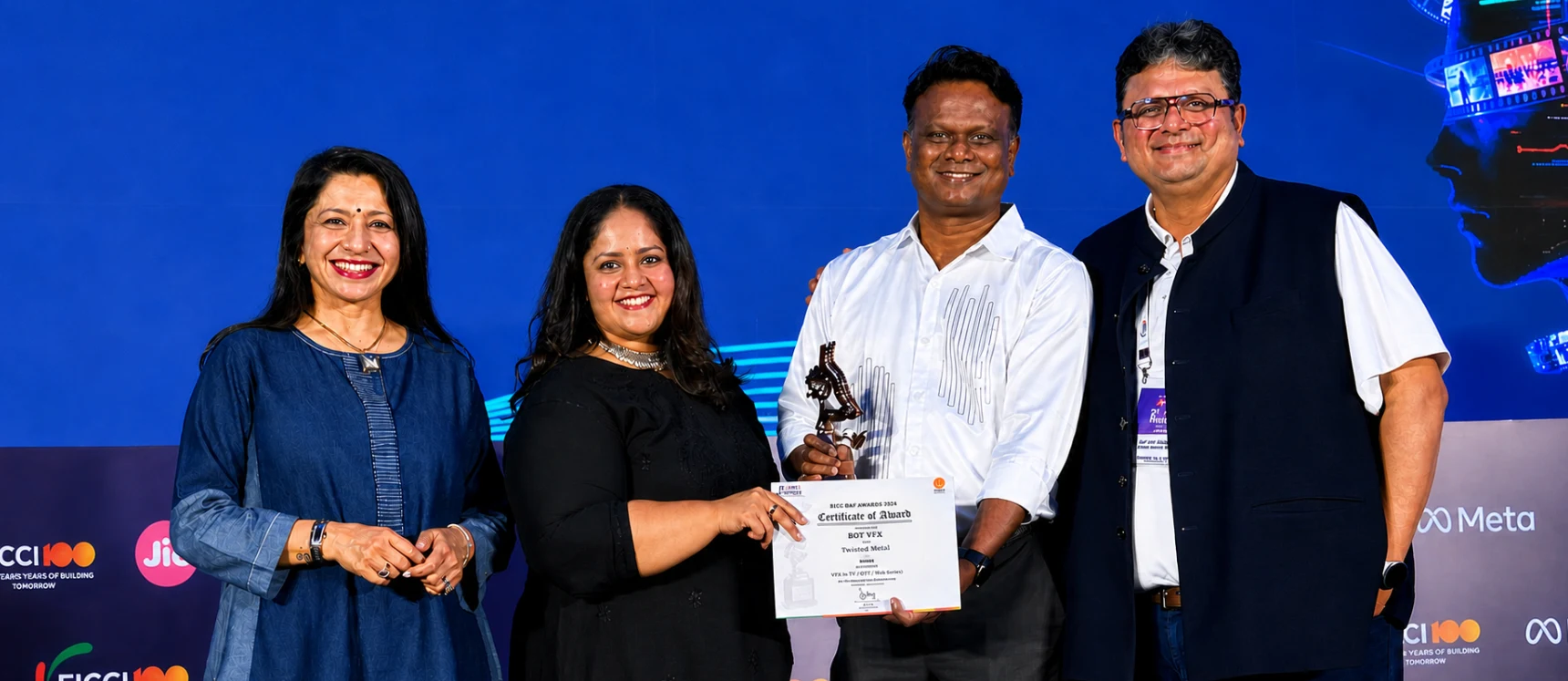
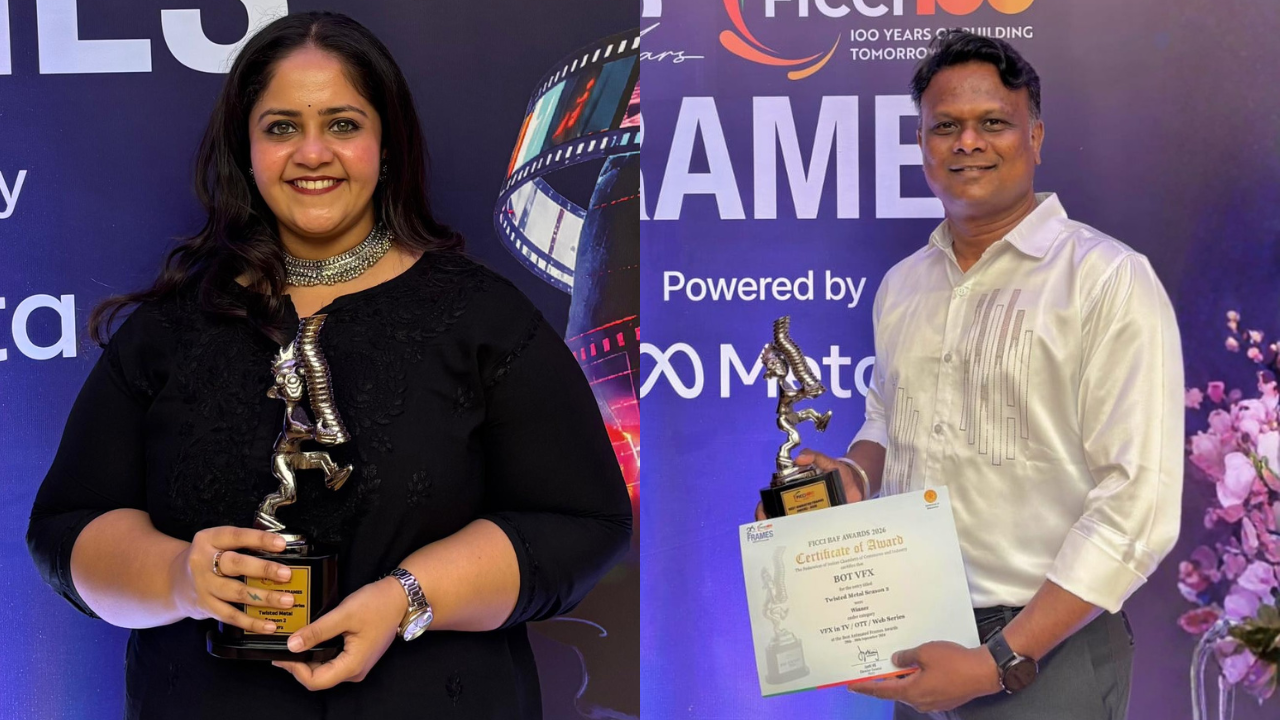
    BOT VFX Wins at FICCI BAF Awards 2026 for Twisted Metal Season 2

    Our team won the VFX in TV / OTT / Web Series award at the FICCI BAF Awards 2026 for our work on Twisted Metal Season 2, the Mesquite Productions series. And yes, we set a lot of things on fire to get here (digitally, of course).

    “We came in for prep and invisible FX, and ended up setting the screen on fire. Winning at FICCI BAF for Twisted Metal Season 2 is a big moment for our team. It proves that when you earn a show’s trust, the work can grow far beyond the original brief.” — John Joseph Britto, VFX Supervisor, BOT VFX.

    From Clean-Up Crew to Full VFX Show

    We joined Twisted Metal Season 2 initially for prep and invisible FX. Under VFX Supervisor Joshua Spivack and VFX Producer Alex Schade, the show scope grew across FX, Lighting and CG, which is just what they had in mind. Some skepticism about BOT early on turned into trust, and the shot count climbed past 800!

    john

    The Love Scene That Lit Up the Room

    The standout was a satirical love scene set in the middle of fiery chaos. It ran to 30+ shots, and it needed fire, smoke, embers and spreading flames that matched the practical elements on set. The look, speed, wind and rhythm all had to sit seamlessly in the live-action plates.

    We built it all in Houdini:

    • It started with a pair of flame-throwers. We had complete creative freedom on these.
    • Then the fire spread, in rhythm with the scene’s pace, until it engulfed the space around the actors.
    • A couple of shots became a dozen. Fire-spread was planned for only a few shots. The director and supervisor liked the results enough to expand it to over a dozen.
    • Late additions kept coming – Sparks, fire bursts and embers were added close to delivery, and they went in smoothly even on tight deadlines.

    To manage the complexity, our team mapped fire elements shot by shot on contact sheets. This mock-up guide became the creative blueprint that carried FX from concept to final render.

    Beyond the Fire

    Fire got all the glory, but the work went well beyond it:

    • CG creations: a water tower, glowing LED strips on car wheels, an extended knife and a torch flame.
    • 2D enhancements: continuity fixes including blood splatters, lip corrections and black-eye adjustments.
    • Green screen: around 13 shots needed a 2D background plate adjusted for perspective shifts and varying lenses. We simulated depth using a 2D approach to keep it natural and cinematic.

    A Win for the Whole Team

    Delivering 800+ shots took 260+ artists, and this win belongs to every one of them.

    • John Joseph Britto — VFX Supervisor
    • Hetal Jain, Rajesh Babu — VFX Producers
    • Simran Jain — Line Producer
    • Vikram L, Benedict Joseph, Amirtha Varshini Sathiya S, Mounitha N — Production Coordinators
    • Meenakshi Sundaram, Elanchezhiyan, Ramakrishna Medi, Manoj Kumar G D, Ganesh Karthikeyan — Department Supervisors
    • Shanmugaraj P, Satish Kumar V, MuthuKumar P — Department Leads

    A big thank you to Sony TV, Mesquite Productions, Joshua Spivack and Alex Schade for the trust and creative freedom. What started as a clean-up, ended with an award!

    BOT VFX Wins Best VFX Feature (International) for Send Help at VAM Awards 2026

    BOT VFX won the Best VFX Feature (International) award at the VAM Awards 2026, held on 15 May 2026 in Mumbai, for our work on Send Help (2026) — the Sam Raimi-directed survival horror-thriller for 20th Century Studios starring Rachel McAdams and Dylan O’Brien.

    “Send Help asked our team to wear many hats – environment work, CG props, atmospherics, character continuity, sometimes all within the same shot. Seeing that range recognised at VAM 2026 means a lot, because it’s exactly the kind of versatility we want to be known for.” — Sreyans Bardia, Co-founder & Managing Director, BOT VFX.

    Across the Board

    Send Help follows two colleagues stranded on a deserted island after a plane crash, and the VFX brief for the film touched almost every department we have.

    The team handled CG asset creation, building out props like a golf club, diamond ring, and knives, modelled and shaded in Maya to match on-set lighting and lens data. We also tackled more specific builds: a digitally enhanced eye on a severed pig head, and photo real blood augmentation on a dead rat.

    Environment work pushed in a different direction. Sparse stretches of forest were thickened through digital foliage and matte-based extensions, rock textures were sharpened with CG overlays and displacement detailing, and monitor screens throughout the film were rebuilt as custom UI composites with accurate reflections and perspective tracking.

    Then came continuity and atmosphere: blood augmentation around actors’ eyes and faces that had to hold up across different lighting setups and camera angles, plate cleanup and corrections across intercut shots, and multi-layered digital rain passes tuned for wind direction and physical interaction with the live-action plates — all managed through a single ACES colour pipeline from ingest to final DI.

    It’s the kind of project that keeps a studio’s range sharp: equal parts creature work, environment building, and continuity craft, inside one production schedule.

    A Shared Win

    Send Help’s visual effects were delivered under VFX Supervisor Everett Burrell and VFX Producer Korey Cauchon, by a roster of vendors that included Fin Design + Effects, ILM, Kojo, LVL UP, and Vitality Visual Effects alongside BOT VFX. We’re grateful for the trust and creative clarity that came with being part of that team.

    On BOT’s side, this win belongs to:

    • Hetal Jain — Executive Producer
    • Swetha Madapuri — VFX Producer
    • John J Britto — VFX Supervisor
    • Ganesh Karthikeyan — 2D Roto Supervisor
    • Sathish Johney — Associate 2D Prep Supervisor
    • Balaji Parthiban — 2D Supervisor
    • Manojkumar Devarajan — Matchmove/Rotomation Supervisor
    • Sivakumar Gunasekar — Matchmove and Rotomation Supervisor
    • Somnath Rithe — Comp Supervisor
    • Nithin S — Associate Central Production Manager
    • Saket Sinha — Line Producer

    …and every artist across the team whose name didn’t make it onto this list, but whose work absolutely made it on screen.

    Send Help asked for a bit of everything, and that’s exactly what this win is a nod to.

    BOT VFX Welcomes Srikanth Swaminathan as Chief Executive Officer

    Some leaders manage a business. Others build the conditions for it to take off and fly. Srikanth Swaminathan is firmly in the second camp — and BOT VFX is thrilled to welcome him as its new Chief Executive Officer.

    Srikanth arrives with over twenty-seven years of experience leading large, complex business operations — full P&L responsibility, cross-functional teams spanning the US, Europe, and Asia, and a career that has taken him from building practices from zero to steering organisations through their biggest, most consequential leaps forward.

    Most recently, he served as Managing Director and Global Delivery Head at Brillio, where he led a major commercial unit across Retail, CPG, Utilities, and Media. Before that, as Managing Director at Investis Digital (now IDX Inc.), he grew the company’s India operations and then held it steady through the turbulence of the global pandemic. Prior to that, he spent close to two decades at Cognizant in progressively senior roles, picking up what he would call a foundational truth along the way: that great teams, strong execution, and adaptability matter at every scale.

    What makes Srikanth a natural fit for BOT is how he thinks about growth. He builds systems, cultures, and teams designed to thrive as complexity grows, not buckle under it. And here is the part that makes the BOT fit feel almost inevitable: given that his career has lived in the world of business, his instincts have always had one foot in the creative. Srikanth is a self-described movie buff who has long been fascinated by the place where technology meets storytelling and visual craft. And BOT sits right at that intersection.

    Away from the boardroom, Srikanth is kept grounded by his wife Aarthi and their two teenage sons, Abhinav and Vidhyuth — who, by his own cheerful admission, are exceptionally talented at ensuring he never gets too comfortable or takes himself too seriously. He is a table tennis player and follows cricket and football with equal enthusiasm, loves a good film, and has a completely unapologetic soft spot for 80’s music.

    We were looking for someone who could build on the momentum we’ve created and help take BOT to the next level,” said Hitesh Shah, Founder & Chairman of BOT VFX. “In Srikanth, we found someone with exactly that — the business acumen, the experience of scaling organisations, and the temperament to lead with both clarity and care. We couldn’t be more excited to have him with us.“

    BOT Welcomes Industry Veteran Christina Wise as Vice President, Revenue Management

    With over twenty-five years of experience spanning theatre, live events, feature film production, visual effects and public relations, Christina has built an impressive career in the entertainment industry. And now, she brings that rich experience to her new role at BOT VFX as its Vice President of Revenue Management.

    She started her career at Cirque du Soleil in Las Vegas, working as a Production Assistant on Mystère at Treasure Island. After relocating to Los Angeles, she worked as a Production Executive on the client side, at Warp Films and New Regency Productions, on Mr. & Mrs. Smith and Jumper. When she once asked the VFX Producer on Mr. & Mrs. Smith why a particular shot didn’t look quite right, he replied, “Because we didn’t shoot a plate.” To which she responded, “What’s a plate?” Thus began her odyssey into the world of visual effects.

    Christina

    Christina went on to work with leading studios including BUF, MELS, MPC, and most recently, Tippett Studio, where she served as Vice President of Business Development. Her credits include Oscar–winning films for Best Visual Effects, Blade Runner 2049 and 1917. Other notable projects include In Time, Agent 47, Wednesday, Dopesick, The Nevers, Twin Peaks: The Return, Call of the Wild, Artemis Fowl and the recently released The Miniature Wife. She became a member of the Television Academy’s Special Visual Effects Branch in 2025.

    Growing up as a “Navy brat,” Christina moved over twenty times by the age of eighteen. Today, her twenty-one year old son is trying to match her record, while training to be a sous chef in Chicago. In her spare time, Christina can be found in Griffith Park, either hiking, learning to golf, or catching a show at the Greek Theatre.

    “Christina’s combination of client-side sensibility and vendor-side experience makes her uniquely equipped for this role,” said Hitesh Shah, BOT’s CEO & Founder. “We’re thrilled to welcome her to the team as we continue to grow and evolve.”

    Momentum 2025: Aligning Leadership for BOT VFX’s Next Chapter

    BOT VFX is entering a new phase of growth—scaling across projects, teams, and ambitions. With this expansion comes the need for sharper alignment, stronger decision-making, and a culture that can evolve alongside the business. To support this transition, we convened Momentum 2025, a leadership offsite designed to reflect on the journey so far, recalibrate priorities, and prepare for what lies ahead.

    At its core, Momentum 2025 focused on strengthening leadership capability, shaping the company vision, reinforcing culture, and creating clarity around the organisation’s next chapter. The offsite created space for leaders to step back from execution, examine how decisions are made, and align on how BOT VFX continues to grow—intentionally and sustainably.

    Understanding Change: The Human and the System

    The opening session was led by Smitha Choudhary, Professor and Head of Department at FLAME University. Her full-day workshop on organizational behavior and change management blended theory, real-world case studies, and hands-on application—tailored specifically to BOT VFX’s evolving business landscape.

    Through discussions, role plays, and industry examples, leaders explored not just the mechanics of change, but the human experience behind it. The session reinforced a critical insight: meaningful change does not come from process alone. It happens when intent, culture, and leadership mindset are aligned—when decisions are precise, and leadership remains empathetic to the people driving execution.

    Leadership from Within

    Alongside the external workshop, BOT VFX leaders led focused discussions across critical areas of the business, grounding strategy in real operational contexts.

    • Discipline of Getting Things Done led by Hitesh Shah
    • Why Vision Matters by Sreyans Bardia
    • Culture Code by Deepak Bohra
    • Finance Acumen Led by Vipul Mehta
    • Six Sigma and Process Excellence sessions led by Sheeba Joy and Anoop AK

    Aligning for What’s Ahead

    The offsite also included collaborative sessions with Executive Producers, who shared approaches to problem-solving and process deconstruction across teams. These conversations helped bridge strategic intent with on-ground execution, fostering stronger cross-functional alignment.

    Momentum 2025 concluded with leadership alignment on BOT 2026 OKRs, ensuring that future goals, execution priorities, and the organisation’s evolving identity move forward together.

    Moving Forward with Clarity and Intent

    Momentum 2025 was about clarity, shared language, and leadership readiness. As BOT VFX looks toward its next phase of growth and the launch of its new identity, the retreat reinforced a core belief: strong execution starts with aligned leaders, a clear vision, and a culture that scales with intent—built on collaboration and powered by value.

    bot-momentum

    Directing GenAI Tools for Real-World Productions


    A View Conference 2025 Case Study from BOT VFX

    AI at the Director’s Table

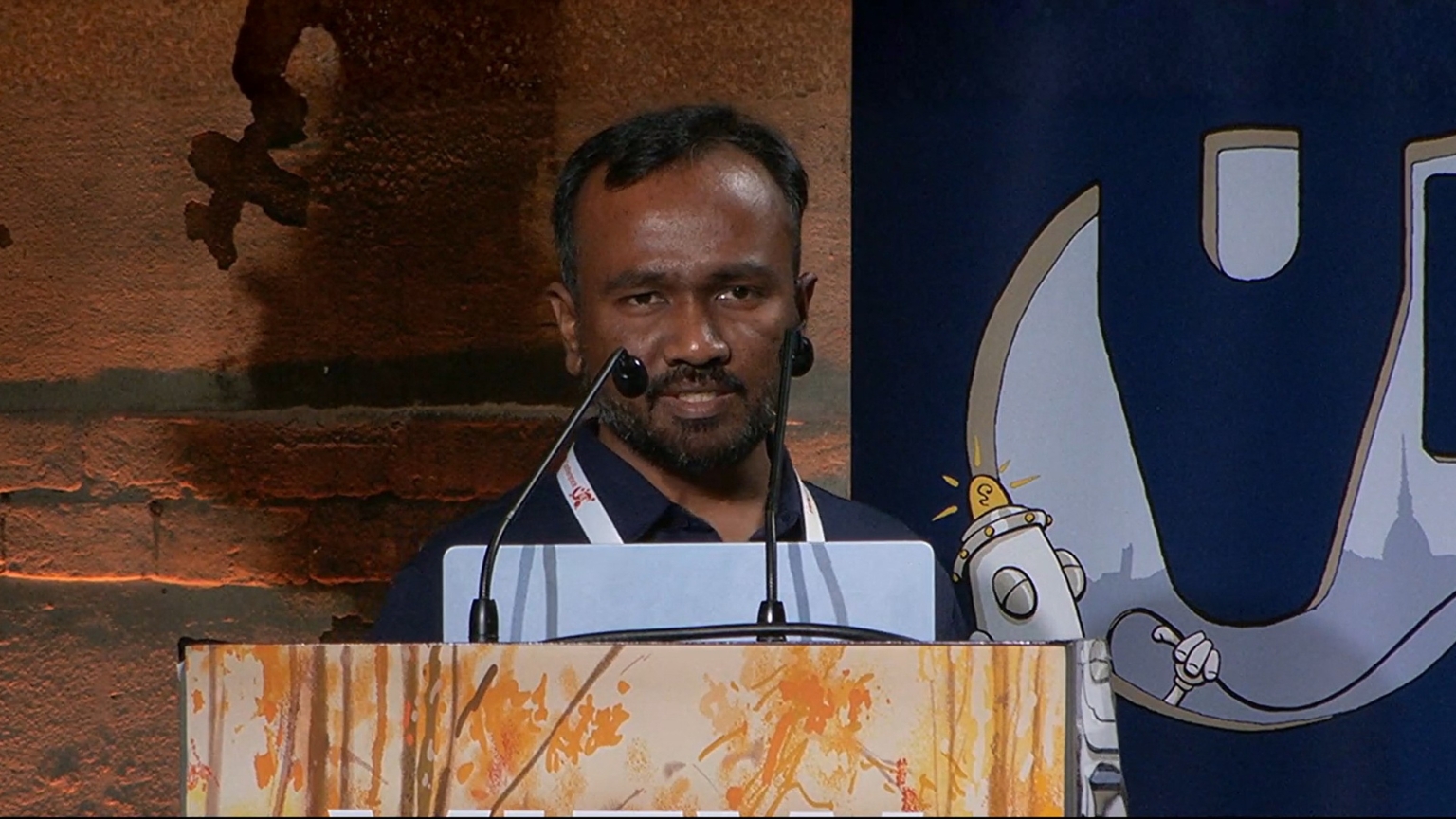
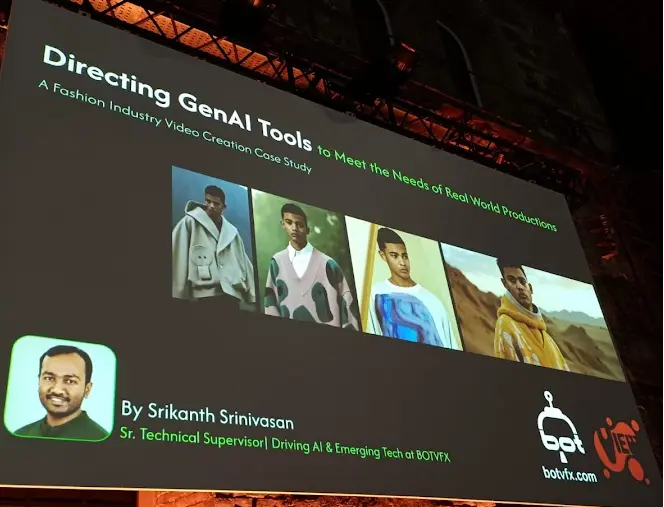
    What if creativity had a new co-pilot? Imagine directing not just a cast and crew, but an orchestra of algorithms—responsive, adaptable, and capable of amplifying your vision frame by frame. That’s no longer a sci-fi fantasy: it’s the new frontier explored at View Conference 2025, where Srikanth S, Senior Technical Supervisor at BOT VFX, unveiled what happens when GenAI steps onto a real-world production pipeline.

    The Project: Trace of One—Fashion Meets AI

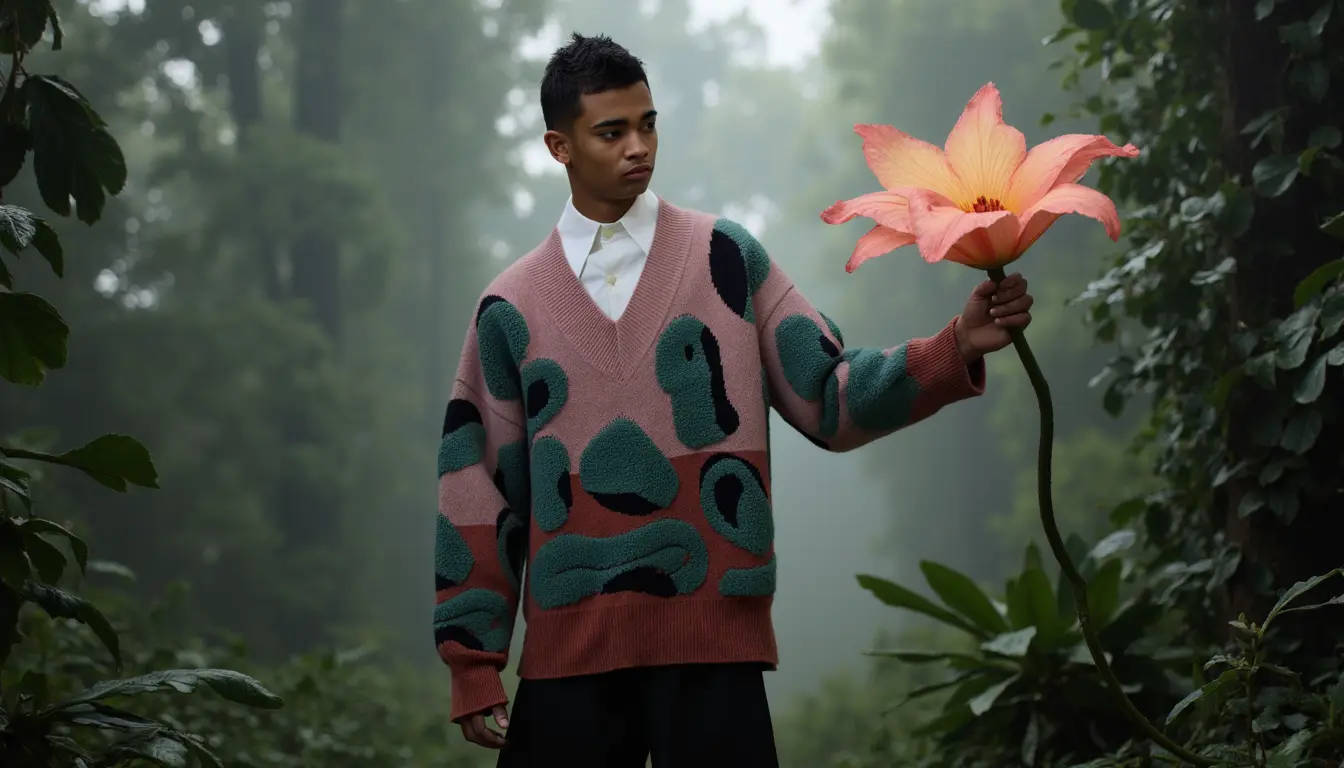
    At the heart of Srikanth’s talk was Trace of One, an experimental short film for fashion designer Mai Gidah. Here, every pixel sprang from generative AI, but every choice—from character pose to camera movement—remained in the hands of human creatives. The team set a high bar: could these new tools deliver outcomes strong enough to satisfy supervisors, clients, and brand storytellers in serious production?

    Srikanth botvfx


    Building the Workflow: Ideas to Final Frames

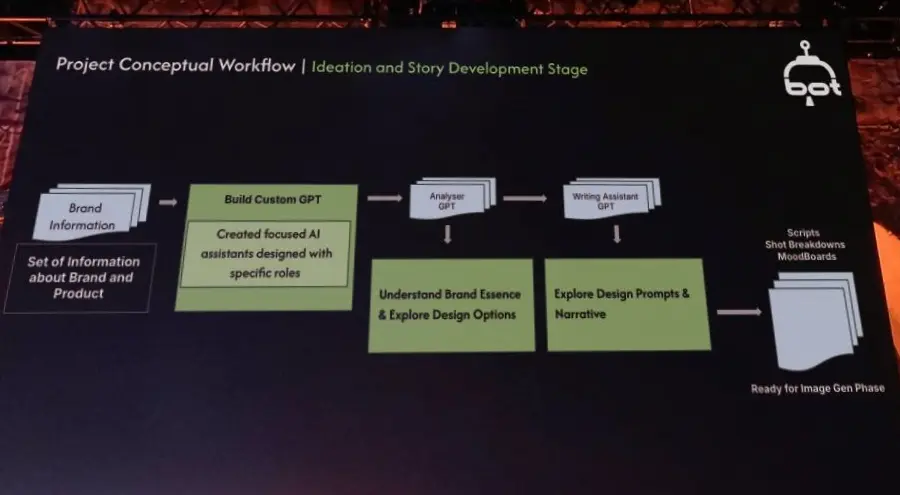
    Production started with big ideas, swiftly supported by GPT-powered assistants. These language models generated drafts and mapped out story structure, working like junior creative collaborators that never overstepped the human impulse for direction and editing.

    conceptual workflow


    For visuals, things got hands-on. The team conducted a real photoshoot to build a data set of fashion models and outfits, trained LoRA models to secure talent and wardrobe consistency, and validated these assets just like you would for key VFX elements—testing lighting, angles, and composition before rolling into full shots and scenes.

    Motion and pacing followed the traditions of film. The artists generated image-to-video takes for each shot, then stitched and refined them using editorial processes that made the final 4K master feel crafted, not random

    Insights from the Session: Structure, Control, Adaptability

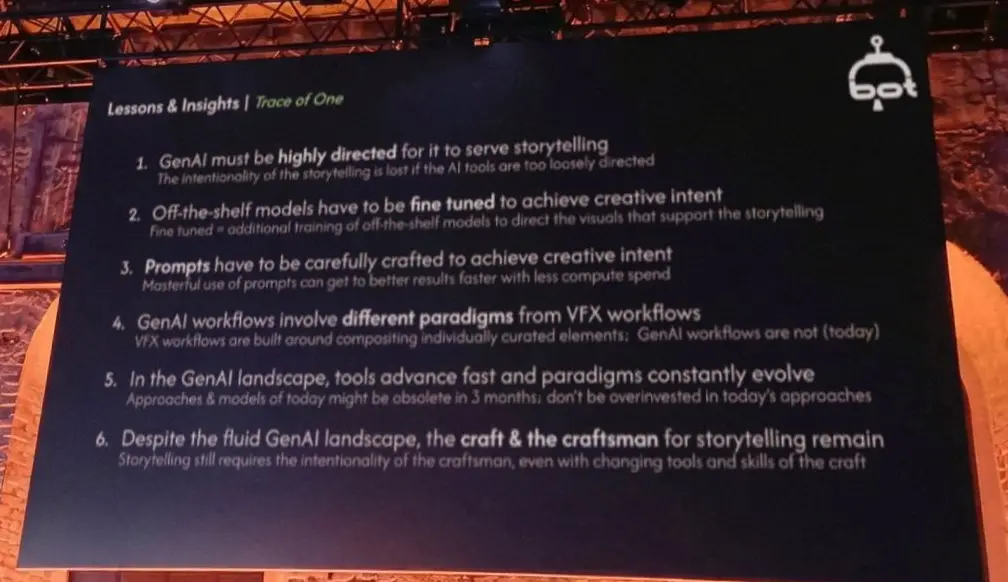
    Attendees at View Conference saw firsthand that GenAI isn’t a magical shortcut. LLMs and generative image models are most powerful when directed with clear intent, acting more like creative partners than generic prompt machines. The excitement wasn’t in flashy outputs, but in blending real product, character design, and branded storytelling with the discipline of a production crew.

    VFX lessons


    Throughout the talk, questions circled around control and adaptability—how does a director keep narrative and style consistent when new AI tools and features arrive mid-project? Srikanth’s answer was practical: flexibility, big-picture thinking, and ongoing iteration are the real sources of competitive edge.

    Lessons for Every Audience

    The Trace of One journey drove home several essential points. GenAI needs a director, not just a button-pusher. Off-the-shelf models won’t recognize your brand story unless you invest in training and refinement. Prompts work best as detailed stage directions, guiding action, mood, and style. AI workflows demand iterative thinking, not just modular tweaks, and adaptability must become a core strength as technology evolves.

    AI BOTVFX


    Most of all, the team found that while tools might change, intent and judgment remain central. AI can expand horizons, accelerate work, and introduce new types of creativity, but only when the people behind the screen steer the process with vision and care.

    For anyone in VFX, film, fashion, or brand work, the future lies in partnerships—between humans and machines, between vision and execution. At BOT VFX, Trace of One stands as proof that with the right direction, GenAI can help create compelling stories, remarkable visuals, and original work that reflects not just possibility, but purpose.

    Bad Boys, Big Win: BOT VFX Crew Ride High at VAM Awards 2025

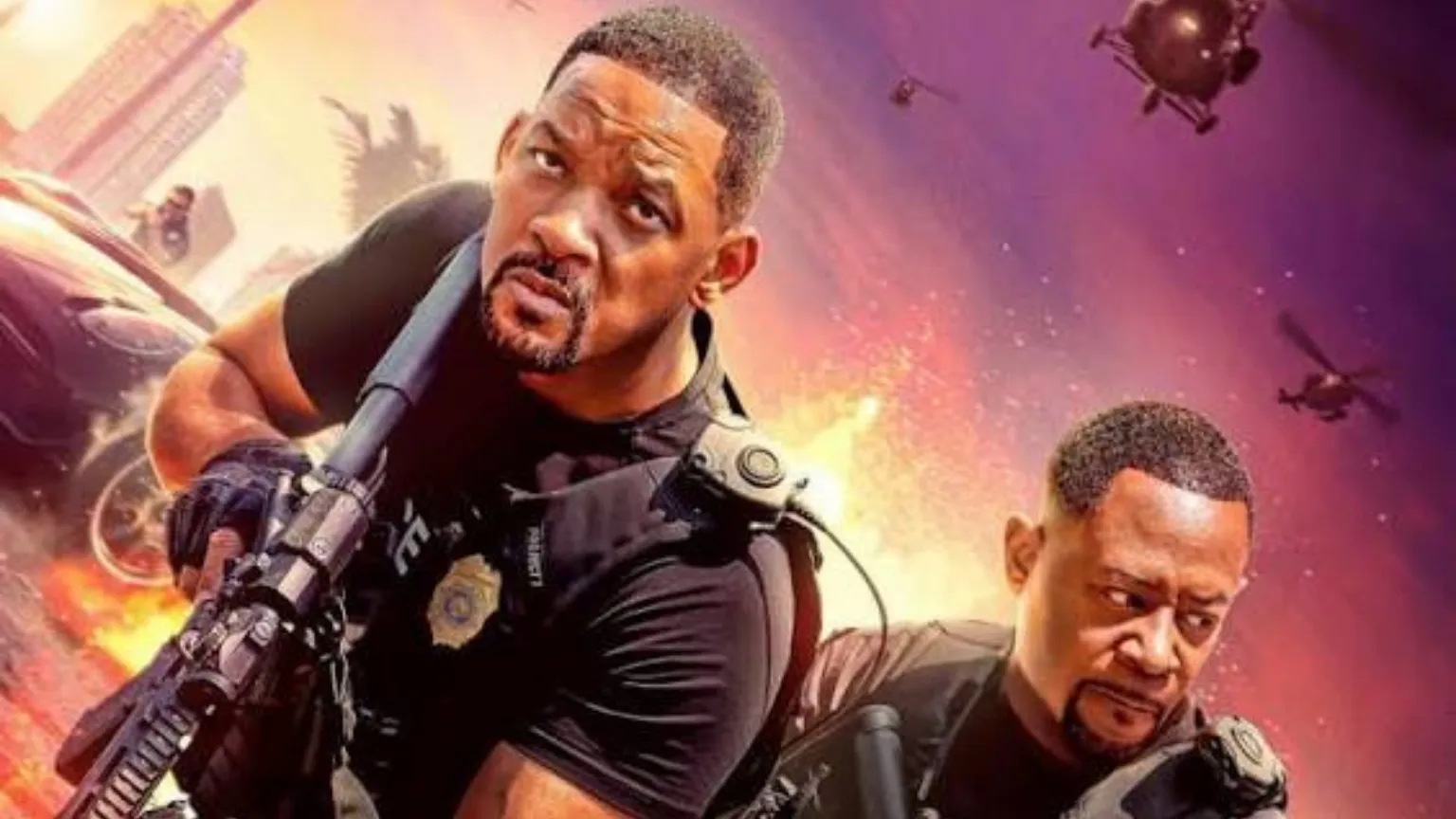
    BOT VFX, collaborating with the talented client team led by VFX Supervisor Kris Sundberg and VFX Producer Lynzi Grant, has clinched this year’s Best VFX Feature – International award at the VAM Awards 2025 for its work on Bad Boys: Ride or Die (2024). It’s yet another high-five moment for all the BOTs – a recognition that reaffirms the hearts we’ve won and the screens we’ve lit up over the years by doing what we love most: delivering high-quality, meaningful VFX.

    “This win is yet another reminder of our ability to further our clients’ creative goals through great collaboration and excellent execution,” commented Hitesh Shah, BOT’s CEO.

    High Stakes, High Standards

    The film, starring Will Smith and Martin Lawrence, is a 2024 action-comedy rollercoaster with a massive VFX appetite. BOT VFX was entrusted with delivering a wide spectrum of shots — each packed with technical complexity and creative nuance. Our work ranged from rig and safety pad removals, skid and crash pad clean-ups, set extensions, to color correction, retimes, and day-for-night transitions.

    Our team also transformed on-location footage, swapping Georgia backdrops with vibrant Miami scenes using blue screen integration, sky replacements, and monitor inserts. These enhancements weren’t just about polish — they were about storytelling, mood-setting, and believability. From high-speed chases to a crashing helicopter’s cockpit, every shot got the BOT touch.

    Creative Collaboration and Leadership

    This win is also a reflection of the seamless collaboration with the VFX leadership at the studio side. BOT VFX is grateful to have partnered with our clients, whose trust, direction, and creative clarity helped steer the visual ambition of the project.

    With over 100 artists contributing across all departments, this project was yet another example of BOT’s ability to scale with speed while maintaining quality and finesse.

    More Than Just a Win

    This recognition is more than an award — it’s a reminder of the trust placed in us by our clients, the craftsmanship of our artists, and the culture of excellence that binds every BOT together.

    Here’s to many more frames, bold collaborations, and storytelling that goes beyond the screen.

    Let’s ride.

    VAM-AWARDS 2024 BOT VFX


    BOT Sponsors VIEW Conference

    BOT VFX was proud to sponsor Speaker Dinners at this year’s VIEW Conference, a premier gathering of industry leaders who provided many inspiring and entertaining presentations about some of the latest achievements in film and technology.  Featured speakers included Director Brad Bird, Composer Michael Giacchino, Director Peter Ramsey, and Writer/Director Dean DeBlois.

    Representing the BOT at the conference last week in Turin, Italy, were Co-Founder and Director of Business Affairs Deepak Bohra, Creative Head Zameer Hussain, and myself, Executive Producer Camille Geier. “The VIEW conference is a rich environment for conversation with our industry colleagues,” Hussain recalled. Bohra observed, “I very much enjoyed the experience of learning even more from masters of our craft.”

    I found the VFX community represented at VIEW to be very inspiring, and the conference is enhanced by the beautiful setting of Turin. Kudos to Maria Elena Gutierrez, Executive Director of VIEW, for assembling an amazing array of speakers and events.